| COSTS |
|
by Valentino Piana (2003), updated in the subsequent years |
| |
| ||
|
Contents |
|||||||||||||||||||||||||||||||||||||||||||||||||||||||||||||||||||||||||||||||||||||||||
| 7. A retailer's perspective | |||||||||||||||||||||||||||||||||||||||||||||||||||||||||||||||||||||||||||||||||||||||||
| 8. A building business perspective | |||||||||||||||||||||||||||||||||||||||||||||||||||||||||||||||||||||||||||||||||||||||||
| 10. Differentiation, costs and quantities | |||||||||||||||||||||||||||||||||||||||||||||||||||||||||||||||||||||||||||||||||||||||||
| 12. Is refusal to sell a marginal cost issue? | |||||||||||||||||||||||||||||||||||||||||||||||||||||||||||||||||||||||||||||||||||||||||
| 13. Spatial differentiation of production costs | |||||||||||||||||||||||||||||||||||||||||||||||||||||||||||||||||||||||||||||||||||||||||
|
A related
paper: The production function
of students' grade
|
|||||||||||||||||||||||||||||||||||||||||||||||||||||||||||||||||||||||||||||||||||||||||
|
|
|||||||||||||||||||||||||||||||||||||||||||||||||||||||||||||||||||||||||||||||||||||||||
|
The burden sustained
in order to perform a certain activity, to carry out a certain production,
to achieve certain goals. In a balance sheet,
costs raise commercial liabilities to be settled. They should not be confused
with money outflows. By contrast, in economics, most formal models ignore this distinction between costs and payments. Actual costs refer to real transactions, wherease opportunity costs refer to the alternative taken into consideration by decision makers who might want to choose the line of activity which minimise the costs. From an external point of view, it is difficult to ascertain which are the alternative considered. Discretionary
costs are not strictly necessary for current production but correspond
to strategic goals (e.g. improving the firm's image through an advertising
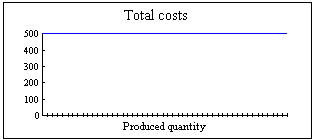
institutional campaing). Attributed costs are computed values from accountancy that are conventionally attributed to products as part of the process trying to establish profitable prices by appropriate routines. Please note that certain companies have just one product (with one or more versions) but that most companies have a plurality of products, with some inteplay between costs attributable to specific products and others that refer to the company as a whole. Given a specific product version, production costs are usually classified according to their responsiveness to different levels of production attained. Fixed costs
are simply not responsive to production levels. If there are only fixed costs, the total costs follow this rule:
For instance, the
cost of renting an office is a fixed cost, since usually the contract
fixes it for a certain period of time (say one
year), without any reference to the income produced by the operations
that take place in the same office. The firm deciding
to rent this office, however, will have usually expected to be able to
afford it as well as to be reasonably sure that it will not be too small
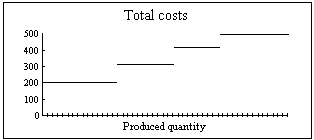
for the kind of operation it intends to carry out. This brings us to an important conclusion: a very common situation is that of quasi-fixed costs. They are flat in a certain range of (expected) production but they are forced to jump to higher levels if certain thresholds are overcome. Near these thresholds, in fact, quality deterioration of output and other negative phenomena take place. Symmetrically, below
other minimum thresholds in level of activities, the same costs become
unaffordable and will probably be reduced. Here you have the graph of
total costs when there are only quasi-fixed costs:
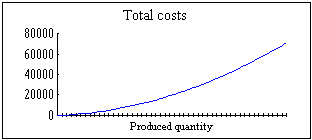
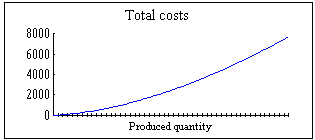
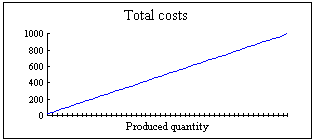
Variable costs grow with higher levels of production (proportionally or not). If there are only variable costs, at zero production the total costs will be zero. Total costs will follow for instance this rule:
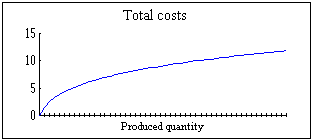
In particular, economies of scale describe situation when the total costs rise less than proportionally to production increases, as you see in the following diagram:
Constant return to scale are the intermediate situation in which the growth in production is exactly matched by the same percentage increase in total costs, i.e. elacticity of costs to production levels is 1:
In this case, productivity is constant. To understand the
sources of economies of scale is helpful to consider that total costs
for production inputs depends on two components: the quantity and
the price of the inputs. Accordingly, it is
often useful to distinguish two broad reasons for cost to rise: an increase
of the input quantity or a soaring price for input. This allow for distinguishing
different reasons for costs behaviours in reaction to changes in production
levels. In particular, economies
of scale can be due: a) to savings in average
physical quantity of input when the production is higher (e.g. electricity
dispersion is lower in percentage when the electricity throughput is high); b) to reduction in prices paid when buying larger quantities (e.g. because of stronger power in purchase negotiation). If sales increase, variable costs rise but fixed costs remain the same. To make experiments with different situations, you can use the free Costs software, distributed by the Economics Web Institute. Economies of scale can be gained at different levels: 1. at product level, in which the quantity (leading to lower costs) refers to the number of products cumulatively done since the beginning of entry into production (for instance of an electric car model); 2. at component level, in which the quantiy refers to the quantity of a component (e.g. the battery of an electric car, which is usually measured in kWh of capacity, with different cars possibly having larger or smaller battery); 3. at platform level (where a number of products share certain machine tools, assembly line), with quantity refers to the sum of all products using the platform (e.g. Tesla Model Y shares 76% of parts with Model 3); 4. at plant level, where space, walls, logistic facilities are shared across all production lines (e.g. all cars made at Fremont plant); 5. at company level, where a number of managerial and fixed assets are shared by all products of the enterprise (e.g. all Teslas share Elon Musk push and financial assets of the company); 6. at supply chain level, where several companies utilize certain standard components, frames, etc., with quantity referring to the total throughput of the supply chain; 7. at sector level, where all companies operating in the industry source from somewhere a certain part of their input (e.g. lithium for those types of Li-on batteries that are used in vehicles) 8. at cross-sectoral level, where companies operating in several industries source from somewhere a certain part of their input (e.g. lithium for all types of Li-on batteries that are used in vehicles, energy plant, houses, etc.); 9. at national level, where the entire GDP of a country and the interconnected cumulated investment in infrastructure (e.g. transport, energy, education, etc.) reduce the cost of operating there; 10. at cross-country level, where a multiplicity of states agree on certain standards, known and implemented in advance and at a lower cost by their companies. The advantage of a specific producer, due to its own economies of scale, tend to be linked to the first five levels. However smart companies may try to gain before others the gain from the other levels as well. In dynamic terms, innovators and early adopters have a longer history of production than laggards; if in the time lag they achieved to produce enough units of the product and/or of its component) and/or gaining other levels of economies of scale, they can propose to the market goods that cannot be easily imitated in terms of performance and price, thus consumers will flow to them and will not be appealed by laggards, who suffer from a cost disadvantage. In this situation, success feeds success and the winner takes all the market. The quantity to which the economy is related can be instantaneous (or more realistically done in a certain period of time, say one year) or be cumulative over time (so it can only rise). Cumulation may be open-ended or having a conventional duration (e.g. for amortization of the fixed cost of setup at the beginning). All this depends of the reasong of the economy. A supplier will typically accept a lower price for large orders, but such discounts cannot lead to zero. At company and product levels, Total costs are the sum of all costs. By dividing the total costs by the quantity produces, one gets the average costs: how much a unit of production costs ("unit cost"). Average costs can
be directly compared with price to compute profitability: if the price
is higher than average cost, the production is profitable. Total profits
will be given by multiplying the average profit with the quantity produced
and sold. Identically, total
profits can be obtain as total revenues less
total costs. The relationship between
total revenue and total costs depending on the production level is analysed
by the so-called "break-even analysis". Let's see mathematically
what component crucially influences average costs at two widely different
levels of production. In the simplified situation of a production process characterised by a fixed cost (F) plus a proportionally-growing variable cost (VC), total costs (TC) are described by the easy formulas below:
where q is the quantity
of good. Average costs (AC) are thus the following:
The first term of
the right side (F/q) decreases systematically the higher the production
level (q). At low production levels, this reduction is quantitatively
relevant wherease for a high q it is not. In fact, for high
q, the average cost is practically equal to variable cost VC. A numerical example of fixed, variable and total costs:
First
case: q = 10 TC
= 100 + 5x10 = 150 Second
case: q = 100 For low levels
of production, fixed costs are major determinants of average costs
whereas for high levels of production, variable costs dominate. The percentage composition
of total cost is, in our example, the following:
To investigate what happens if many firms are competing with different combinations of fixed and variable costs, see this paper and the related software. Marginal
costs indicate by how much the total costs changes because
of modification in the production level by one unit. When there are only fixed costs, marginal cost will be zero: any increase of production does not change costs. If there are only proportionally-growing variable costs, marginal costs will be equal to variable costs. To see which are the relationships among marginal, average and total costs, you can use the free Costs software, distributed by the Economics Web Institute. 6. A manufacturer's perspective The
main costs that a manufacturer faces can be summarised in the following
table:
The above-mentioned table is just a rough and conditional description. It is only meant for easy introduction to the problem - often implicitly assuming many specific hypotheses. For instance, the labour costs can be fixed costs, quasi-fixed costs or variable costs depending on the legal contracts of employment and the rules governing wages. General firm strategies have deep impact on costs. For instance, if a firm in a high-wage country exports a lot in a low-wage country, it may consider a Foreign Direct Investment to setup a factory there where to carry out the final - or most labour-intensive - phases (e.g. assembly or labelling). Taxes are not costs in accountancy terms: they are paid out of added value, i.e. the difference between turn-over and costs. They reduce the profits earned by the firms. The
basic costs that a family-run small shop pays are the following:
Total revenues less all these costs constitute a gross profit, comprehensive, however, of the time the owner and the family spend working there and of the shop space (if in ownership). This logically heterogeneous aggregate is in fact indivisible because it is received by the same people and does not vary according to the external markets of labour and commercial spaces. The market of a good where seller and buyer are the same person is not perfectly competitive, nor linked to others. Large retailers chains (including supermarkets and hypermarkets) negotiate the purchasing prices with producers, often achieving rabates in function of the sold quantities, to the effect that goods in sales are less-than-proportional variable costs. Logistics is a major cost component, largely dependent on its spatial organization and distances travelled by wares. Personnel is usually hired as in manufacturing sector. Other cost components are somehow similar to the abovementioned analysis. 8. A building business perspective In the building industry, it is not uncommon that the delivered product is "one" building, not many replicas as in manufacturing. So sales are "one" and this prevents the conventional categories of variable costs to apply (since sales are not many). In this case, variability can be looked for with respect of other quantitative parametres, but the conventional analysis remains severely limited. The
basic costs that a building firm pays to build one residential building
are - as a very simple approximation - the following:
More in general, urban transformation and regeneration requires not only new buildings but accessibility, mobility services, new infrastructure and many components to be financially, economically, socially, envioronmentally and culturally sustainable. 9.
The temporal profile of costs: investment, cost of operations, sunk costs In most cases, a firm has first to sustain certain costs (investment) before any production takes place (e.g. R&D, machinery investment). These costs are called pre-operational costs or investment costs. These costs should be recovered within a reasonable period of operative activity (production). In certain cases, after the full exploitation of production opportunities there is a further una-tantum revenue for asset sale. For instance, when
a firm buys an office, it invests a certain amount of money. It will use
it for a certain period, say 10 years, during which it saves the rent
it would have paid if it didn't own the office, thus (totally or partially)
recovering the initial cost. At the end of the 10-years period, it can
decide to shut down operations and it will be able to sell the office
(una-tantum revenue). Sunk costs are investment costs incurred before a certain activity takes place which cannot be recovered by the possible sale of the asset they produced. Highly specific investment
(e.g. R&D) are usually sunk costs. A particularly radical type of
sunk costs are pre-operational costs (e.g. feasibility studies) that do
not open the possibility of carrying out the activities (e.g. because
they established that the project is not feasible). In such cases, no
activities are later carried out and no way to recover them is available.
Sunk costs give the upper hand to well-established firms or firms profitably operating in other markets, since they can afford them, whereas new entrants with just a narrow own capital will usually not be able to afford the risk to have high sunk costs. In another vein, you need to be rich to start a new business. A poor most often does not have the capability to cover pre-operational costs, nor a bank will make him a loan because of a lack of collateral. Only microfinance can help in this case (and with many limitations). In another perspective, sunk costs represent barriers to exit. A firm which has incurred in high sunk costs will have difficulties in deciding to exit the market even if it sees good opportunities outside. Conversely, a firm that is deciding whether to enter into a certain business will have to consider with a particular attention the sunk costs and the risk that during the operations period they might not be recovered. Sunk costs, in this perspective, represent barriers to entry. In the case of an exporter, an example of sunk costs could be the costs of analysing the market and of exploring opportunities and seeking commercial partners. "The more the setting up of an activity is innovative, the more is it likely to involve long periods of gestation, and thus higher sunk costs" states Prof. Sergio Bruno in "The economics of ex-ante coordination". High sunk costs makes an investment irreversible, what, couple with uncertainty about the future, impacts the level of investment by industry, as this empirical analysis points out. A narrative example of sunk costs in a real-world situation is given here. 10. Differentiation, costs and quantities Until now we considered the costs for one specific version of a product. But products are typically widely differentiated (horizontally, vertically and in more complex geometries). In particular, if a producer assembly components purchased by suppliers, then the following relationships are typical: a. when purchasing a small number of pieces, they will be typically standard pieces, for which it will pay more than the buyers of large quantities (this situation characterises small new entrants having to compete with large established companies: they pay more for the same components); b. when purchasing a larger number of pieces, they can ask for customized parts, for which it will need to pay the R&D, the specialised capital at suppliers and many additional cost items. It is possible that the suppliers will ask the legal possibility of producing the same pieces for others; c. when purchasing a very large number of pieces, the suppliers can not only customize the parts but gain its own economies of scale, so offer them at a relatively low price, even giving the exclusive right of use to the customer (this situation characterise a successful innovator that is locking-in its competitive advantage). By having customized
parts (and/or a customized plant), the final product can be differentiated
from competitors. 11. Profitability and shut down rules In one period of time, total profits are given by total revenue less total costs. If they are negative, the firm will look into the future and see whether there is a possible reversal of this situation. Perhaps it is carrying out investments that are large now but that can produce effects later on. But it can also take into consideration the possibility of shut down operations and exit the market. It will, for instance, evaluate the average variable costs and the current price. If the price is lower, then for every units of production the price doesn't recover even the direct costs. A very critical situation. But exiting a market is a strategic decision that cannot be taken wholehearted and it should be put into the more larger picture of industrial dynamics, where exit dynamics is related to more than just cost considerations, as for instance empirically demonstrated in this paper. To see the balance between entry and exit in a market where fixed costs and variable costs are firm-specific see this paper and the related software. In particular, cashflow and debt problems play a crucial role in increasing the risk of default, because firms take credit to fund both current business activities and investment (e.g. in fixed assets). The availability of credit depends on creditworthiness, which in turn is linked to real and perceived risk in the specific market and country-wide. In other terms, bankruptcy can happen even if the price cover the costs, but the firm has become, for other reasons, unreliable and nobody provides necessary credit. In a less drammatic condition, multiproduct firms (selling more than one product) might decide to sell some of its products at a price lower than unitary cost (or of marginal cost), recovering the losses by selling more of the others. This is very common for large retailers and supermarkets which promote (temporarily or permanently) their overall sales by demonstrating exceptionally cheap some reference products (be they well known industrial brands or phantasy brands of their own). Far from being a critical situation, this competitive strategy is a sign of strength. Indeed, if below-cost prices are used to eliminate competitors (for which the product at hand represents a very substantial share in sales), this predatory price strategy is effective in two versions: either the price bounces back to higher-than-cost after the competitor has shut down or it is kept constantly lower-than-cost to keep competitors out of the market (and balancing the losses on it with margins on the other products sold). 12. Is refusal to sell a marginal cost issue? The neoclassical theory of costs assumes that marginal costs are rising and that producers will refuse to sell a further unit after the equilibrium quantity because the price does not cover the larger marginal cost it requires. An exploration of this case and of realistic reasons to refuse to sell is here. 13. Spatial differentiation of production costs The cost of production can be widely different in geopolitical areas where the labour cost, the energy cost, the land cost, interest rates, and other prices are different (thus violating the Purchasing Parity theory). In principle quantities should be the same (material input needed, intermediate goods, hours of labour, etc.). In fact, the productivity of people and machine is largely dependent on historical reasons, with path dependency and place-dependency, to the effect that also quantities can widely vary across areas. Appendix: Some simple relations between marginal costs and average costs If to an average of 5, you add a 6, the new average will be higher than 5. If the cost of a further unit is higher than the average cost of all preceding units, the average cost will rise. If marginal costs are higher than average costs, the "average cost curve" will be upward sloping. You can experiment with these relationship through this MS Excel file.
Costs: a software to understand cost structures Cost structures and their impact on prices in a monopoly market R&D, advertising and other costs in dynamic competition Marginal and average costs: a spreadsheet to understand relationships Isoquants: a software for understanding the neoclassical production choice theory Return to scale: an empirical estimation in UK Costs in manufacture from aggregated balance sheets
|
|||||||||||||||||||||||||||||||||||||||||||||||||||||||||||||||||||||||||||||||||||||||||