| Economic data |  |
||||
| Software | |
||||
| Essays | |
||||
| Key concepts' glossary | |
||||
|
|||||
|
|||||
| Links | |
||||
|
|||||
|
|
|||||
|
|||||
|
|
|||||
| Topics | |||||
|
|||||
|
Industrial dynamics | |
|||
|
|||||
| Labour market | |
||||
| Consumer behaviour | |
||||
|
|||||
|
|||||
Methodology |
|
||||
|
Geopolitical areas
|
|||||
| Africa | |
||||
| Asia | |
||||
| Europe | |
||||
| Latin America | |
||||
| North America | |
||||
| Oceania | |
||||
| World | |
||||
|
Specialised entry pages for
|
|||||
|
|||||
|
|||||
|
|||||
|
|||||
|
|||||
|
|||||
|
|
|||||
 |
|||||
|
Magnetized by European Union policies and structures, the European model of development, based on quality of life, welfare state, democracy, tolerance, historical heritage, industrial and post-industrial development is reforming itself to gain a new leadership in a more just world.
|
| Contents |
|
Essay: Real
change is expensive, but necessary: the UK Labour Manifesto for
the Economy + the
Overall Manifesto (2019) How to fund the unprecedented investment in humans (education, early childhood, health) and the environment (renewable energies, electric vehicles, protection of the biodiversity): a bold vision from UK. Free broadband for all, six years of free training for adults, 150000 new affordable houses, free buses for the youth up to 25 years old: this can be financed by the polluters pay principle, with a windfall tax on oil & gas companies, based on historical responsibility for climate change and other taxes on the super rich. These are just some example of a radical manifesto. Presentation: Grey networks for green - an empirical sociological analysis of the role of the organizations of the elderly for the environmental challenges (2018) Essay: 2015 Review of Employment and Social Developments in Europe (ESDE) by the European Commission - and previous releases PDF (2015 - presented in January 2016) PDF (2011)
Essay: A Review of the UK Economy in 2015 An analysis by Economists for Rational Economic Policies Data: How EU is progressing in sustainable development indicators 2015 data for all members and in aggregate. Data: Long-term interest rates in the EU countries Interest spread across Europe. Essay: The 2020 European Union strategy (March 2010)
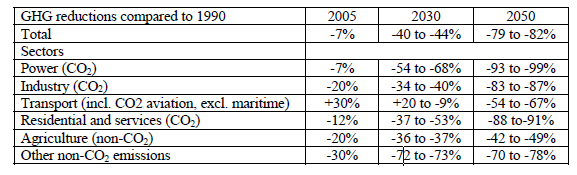
Essay: Policies for a sustainable job-rich recovery - by ILO Essay: A proposal for green growth, innovation and other policies opening the way out for EU crisis Essay: The EU 2050 de-carbonization road map
Essay:Europe’s crisis without end: The consequences of Instead of fostering innovation, productivity and raising wages to sustain consumption, Europe undermined the income and demand generation process via wage stagnation and widened income inequality. The stimulus from German re-unification and the low interest rate convergence produced by creation of the euro prompted a ten year credit and asset price bubble that created fictitious prosperity. Postponing stagnation in this fashion has had costs because it worsened the ultimate stagnation by creating large build-ups of debt, which frame austerity as never ending self-propelling dynamics.
Essay: Addressing a missing element in the Toledo Declaration with industrial ecology (May 2011) A landmark of urban regeneration policy for EU, the Toledo Declaration, amidst the call for an integrated approach to address sustainability challenges by the declaration, exhibits a predominant focus on using local actions to solve local problems. The author, a Singaporean scholar, provides a few possible strategies to cope with the issue, after a longitudinal study showing a specific case. Software: Social security A very simple software where you can verify the economic sustainability of pension scheme reforms in a population, depending on retirement age, wages, payroll taxes, age of labour market entry, births and deaths. Useful to elaborate on the reforms carried out in EU Member states, also in relationship to the EU Commission White paper on pensions. Highly customizable in parametres.
|
| Essay: The financial crisis, austerity and the perspective of failure (September 2010) The turmoil in the Eurozone is due to the global crisis of financialisation that broke out in 2007. But it is also due to the biased nature of the European Monetary Union (EMU). Systematic pressure on labour has intensified the disparities of competitiveness among Eurozone members, splitting the Eurozone into core and periphery. The competitiveness of the core has benefited from extraordinary pressure on workers' wages which, in Germany, has meant practically stagnant real wages for well over a decade. Loss of competitiveness has entailed systematic current account deficits for the periphery, mirrored by equally systematic surpluses for Germany. The eruption of generalised instability in late 2009 reflects these profound imbalances within the Eurozone. Rescuing the banks has come at the cost of austerity, with negative implications for European economies and societies. Austerity will compress public expenditure and weaken private consumption, i.e. the elements of aggregate demand that have shown some vitality during the recession of 2008-9. Given the collapse of investment and the retreat of credit, austerity has increased the risk of recession.
|
| Economic data: CO2 and other GHG emissions in Europe (May 2009)
|
| Book: Russian State Policies in Current Foreign Trade This recent book explores and describes the main implications and possible perspectives of Russian state policies in the foreign trade, not only against the background of the current economic situation in the country but also including political processes in the world to the extent that is necessary to understand their implications.
|
| Economic data: Daily time spent on different activities by employment status, sex, and age (Italy) MS Excel [19 KB]
|
| Book: Energy for the future: Renewable sources of energy White Paper for a EU strategy and action plan. Book: Towards a European strategy for the security of energy supply White paper.
Book: Eliminating World Poverty: Making Globalisation Work for the Poor White paper from the UK Department for International Development (DFID), responsible for promoting sustainable development and reducing poverty. Book: European transport policy for 2010 It was the 2001 when these policies were proposed: improving quality in the road sector, revitalising the railways, controlling the growth in air transport, linking up the modes of transports, rationalising urban transport, halving the number of accidents deaths, going towards gradual charging for the use of infrastructure. Book: Growth, Competitiveness, Employment: The Challenges and Ways Forward into the 21st Century EU white paper ("Delors' plan")
|
| Economic data: Consumption expenditure by income classes in Italy A typical monthly expenditure structure for different consumption needs, differentiated by income classes of the households. The confirmation of Engel's law of decreasing importance of food (the higher the income) is accompanied by a host of other interesting features.
|
|
Economic data: EU data for all the variables in IS-LM model (Germany, France, Italy, Spain, UK, Switzerland and other 13 European countries) MS Excel [550 KB] Economic data: European Economy Yearbook Autumn 2005 Spring 2005 Autumn 2004 Spring 2004 Autumn 2003 Spring 2003 Economic data: Forecasts about the European economy
|
| Essay: The pricing behaviour of firms in the Euro area This study investigates the pricing behaviour of firms in the euro area on the basis of surveys conducted by nine Eurosystem national central banks, covering more than 11,000 firms. The results, robust across countries, show that firms operate in monopolistically competitive markets, where prices are mostly set following markup rules and where price discrimination is common. Around one-third of firms follow mainly time-dependent pricing rules while twothirds allow for elements of state-dependence. The majority of firms take into account past and expected economic developments in their pricing decisions. Price stickiness is mainly driven by customer relationships – explicit and implicit contracts – and coordination failure.
|
| Essay: Does innovation policy matter in a transition country? Prof. Attila Havas demonstrates in this paper the simultaneous need for systemic institutional changes and macroeconomic stabilisation in order to improve microeconomic performance. Whithin an evolutionary economics framework, innovation policy is examined both theoretically and empirically in the case of an European country currently undergoing deep structural changes: Hungary.
Book: UK Innovation Strategy
Essay: Technological Regimes and Innovation: Looking for Regularities in Dutch Manufacturing The Pavitt taxonomy tested and refined.
|
| Economic data: Productivity in 99 countries (1950-2000) An international comparison of productivity levels over time.
|
| Economic data: Readership of daily newspaper by occupation (Italy)
|
| Economic data: An international comparison of 13 key indicators of innovation: the European Innovation Scoreboard (2002)
|
| Economic data: Lending and deposit interest rates in 13 EU countries (1980-2001) 92 national interest rates have been identified and allocated to ten broad categories - six for lending rates and four for deposit rates. MS Excel [180 KB]
|
| Economic data: Gross domestic expenditure on R&D by source of funds in 71 countries in Europe and beyond
|
| Economic data: 2005 R&D spending in Europe, China, Japan and US
|
| Essay: Irreversible investment in Spain firms A dataset of Spanish manufacturing firms provides an important empirical evidence that business investment - at micro level - is infrequent and lumpy.There are periods in which firms decide not to invest and periods of large investment episodes. Rocío Sánchez-Mangas develops and tests consider a dynamic discrete choice model of irreversible investment with a general specification of adjustment costs including convex and nonconvex components. Essay [200 KB]
|
| Essay: Country concentration of Turkish exports and imports over time Through international trade, countries develop their own net of privileged partners. Turkey is an extremely interesting example of a fast changing developing country. In this paper, Prof. Güzin Erlat shows not only data analysis but also a methodology to address the issue of concentration and diversification of exports. The Product Cycle Theory of international trade is given further data support. To generalise this findings, you can look at the data of export composition for 182 countries or explore the huge dataset that tracks importers, exporters, and products.
|
| Economic data: Personal and government savings in Germany, USA, Japan: a short-run comparison
|
| Economic data: Savings behaviors in the UK population (2000 and 2001) A commented overview of the micro-data results of a survey on savings rules. The survey has identified four savers’ profiles: Saving Shortfallers - those who struggle simply to make ends meet and who say they cannot afford to put anything by for the future (18% of the population); Saving Shirkers - those who believe that life is for living, who live for the day, and, as a result, save very little (13%); Sometimes Savers - those who realise that they need to save more but make inadequate and haphazard attempts to save on an occasional basis (29%); Savvy Savers - those who believe in the importance of saving and save as much as they can. They tend to have a long-term savings strategy (38% of the population). Over half of the respondents wish they had started saving earlier. Dynamics available thanks to a second survey in 2001. PDF [860 KB]
|
| Economic data: Comparable wages for 162 jobs in 132 countries The MS Excel file with a user-friendly interface of the excellent dataset by Freeman - Oostendorp. Long-term time-series from 1983 to 1999. This data set allows for comparison of wages across countries for the same job, over time, underlining the differences between skilled and unskilled works. MS Excel [2.9 MB]
|
| Essay: The Housing Market and Europe's Unemployment: A Non-Technical Paper Essay: Unemployment, Well-Being and Wage Curves in Eastern Europe
|
| Economic data: Health and disease statistics worldwide Compare European results with those attained in other areas.
|
| Economic data: Total expenditure on health in OECD countries (1960-2000)
|
| Essay: Regional differences in public health quality management systems The reform of health system aimed at higher quality and lower costs is a challenge with different possible answers. A comparative analysis of development path within a regionalized Italy.
|
|
Economic data: Life expectancy and healthy life expectancy (HALE) (55 countries)
|
| Economic data: Human development index (162 countries) A rich report for reflections and data.
|
| Economic data: M1 data - a long-term money time-series for 19 countries (France, Germany, Greece,...)
|
|
Economic data: Quality of education: 16 indicators Academic attainments in math, literacy, ICT,...; participation, completion and drop out rates; resources... Belgium, Denmark, Germany, Greece, Spain, France, Ireland, Italy,Luxembourg, the Netherlands, Austria, Portugal, Finland, Sweden, the United Kingdom,Cyprus, Hungary, Poland, Romania, Slovakia, Latvia, Estonia, Lithuania, Bulgaria, the Czech Republic, Slovenia
|
| Economic data: Education attainments in reading: a comparison of 35 countries with trends An exceptional survey by IEA’s Study of Reading Literacy (PIRL), with microdata available. PDF [8 MB]
|
| Economic data: Composition of public expenditure (education, health, defence...) - 69 countries in Europe, Asia, Africa, America (1975-1985)
|
| Economic data: Tax revenue in OECD countries (1966-2000) plus a comparison in tax systems
|
| Economic data: Environmental taxes in 15 European countries (1980-1999)
|
| Economic data: Tax competition in EU15: what is the reality? Data and reflections (June 2004)
|
| Economic data: Income, consumer expenditure, and price level in a UK regional comparison
|
| Economic data: Simplified aggregate balance sheets: a time series Turn-over, value added, profits, employment and other firm data during the business cycles: the Italian case.
|
| Essay: Does Schumpeterian Creative Destruction Lead to Higher Productivity? Evidence on Entry and Exit in Portuguese Manufacturing Productivity growth patterns have been widely discussed in the literature at both macroeconomic- and industry-level. But growth takes place in individual firms. Understanding resource reallocation at the micro level, and its relationship with industry productivity growth, are thus crucial in designing new industrial policies. The neo-Schumpeterian models of Nelson and Winter are tested with an original and statistically representative panel of manufacturing firms covering the period 1991-2000 (annual observations). Essay: Analysing the pre-exit performance of French manufacturing firms
Book: From Economic Convergence to Convergence in Affluence? Income Growth, Household Expenditure and the Rise of Mass Consumption in Britain and West Germany, 1950-1974
Essay: EU productivity and competitiveness: can Europe resume the catching-up process with US? Country-level, industry-level and firm-level productivity in EU are compared with US and a policy for productivity catching-up is proposed. Debate site: Foreign Policy Center A leading European think tank, the Foreign Policy Centre has been launched under the patronage of the British Prime Minister Tony Blair to develop a vision of a fair and rule-based world order.
Debate site: Database of best practices in e-government (labour market, social inclusion, regional development,...) Debate site: Corporate Europe Observatory A European-based research and campaign group targeting the threats to democracy, equity, social justice and the environment posed by the economic and political power of corporations and their lobby groups.
|